
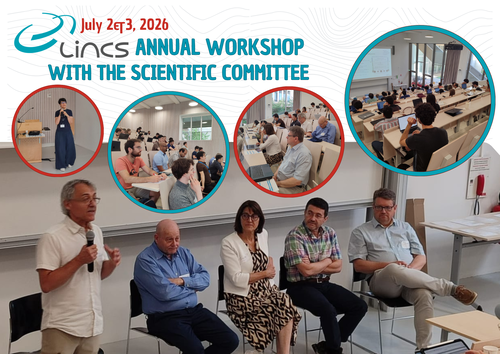
As is tradition, we are pleased to invite you to the 2026 edition of our Annual Workshop with the Scientific Committee : a two-day event taking place on July Tuesday 2 and Friday 3 in Palaiseau, featuring scientific highlights, surveys, elevator pitches, and posters from our scientific community.
Programme
Thursday, July 2, 2026 |
|
| Coffee reception | 9:00/9:30 |
| Opening by Sébastien Tixeuil (SU) | 9:30/9:35 |
| LINCS scientific focus and achievements by Sébastien Tixeuil (SU) | 9:35/9:45 |
| Quantum 2.0 @LINCS
· Survey by Ludovic Noirie (NBL) – 30’ The 2nd quantum revolution (Quantum 2.0) is about manipulating quantum superposition, quantum entanglement and individual particles (intrinsic probabilistic behavior of quantum systems). Quantum 2.0 technologies that are emerging are quantum computing, quantum communications (including quantum key distribution systems), quantum networks and quantum sensing. In this presentation, we will show how the LINCS addresses this research domain, with a focus on quantum network activities. · Scientific highlight by Iain Burge (TSP), «Quantum Support Vector Machines for Anomaly Detection » – 15’ In their initial conception, quantum support vector machines (SVM) leverage multiple sophisticated subroutines as well as quantum RAM to perform supervised learning. Two of these requirements present issues. First, the subroutine of HHL to invert matrices requires a well structured kernel matrix, which depends on the dataset and data embedding. Second, quantum RAM is a controversial tool, and may not be |
9:45/10:30 |
| Coffee break | 10:30/11:00 |
| Enabling Distributed Intelligent Services at the Network Edge, Invited talk by Leandros Tassiulas (Yale University) – 30’
In this talk we present our recent results addressing a variety of challenges in delivering intelligent services at the network edge. We first introduce a multimodal federated learning framework for on-device wireless jamming detection that combines signal representations with network-level measurements, achieving improved accuracy while reducing communication overhead and preserving privacy. We then present a collaborative inference architecture for LLMs that dynamically partitions computation between edge devices and servers, significantly improving system throughput under resource constraints. To support domain-specific intelligence, we discuss the development of telecommunications-focused LLMs that outperform general-purpose models on specialized tasks. We further explore a multimodal retrieval framework that aligns time-series data with textual context, enabling more effective cross-modal reasoning and prediction. Finally, we highlight emerging geometric approaches to LLM design that leverage non-Euclidean representations to better capture semantic structure. |
11:00/11:30
|
| PhD Elevator Pitch Antoine Lunven (Inria), Doan Dai Nguyen (Inria), Baptiste Corban (Inria), Bo Pan (SU), Tengfei An (SU), Hanaa Tabet-Aoul (NBL), Jules Sintes (Inria), Julien Cardinal (Inria), Lorenzo Di Filippo (SU), Luis Muñecas Tomás (NBL / Inria), Ngoc Nguyen (NBL)
|
11:30/12:30
|
| Lunch buffet-style in the inner garden | 12:3O/14:00 |
| NTN @LINCS
· Survey by François Baccelli (Inria / TP) – 15’ This talk will survey the work of LINCS on non terrestrial networks. It will cover research activities, platform developments, industrial projects, and interactions with governments and regulatory agencie. · Scientific highlight by Ashutosh Balakrishnan (TP), «Doppler-Shannon Association in Vehicular Networks: Going Beyond Closest Point Association Policies» – 15’ Low earth orbit (LEO) satellites are emerging as a key theme, providing ubiquitous connectivity for upcoming 6G networks.
In this work we consider a dynamical cellular communication network in which mobile base stations are modeled as a homogeneous Poisson point process on 2D plane. Each base station moves at a constant speed in a random direction. A typical user connects to the nearest base station and it experiences variable signal and interference powers depending on the distance of all the stations. Along the motion of the stations, the user swaps its serving station, and such an event is called a handover. We are interested in the performance evaluation of the system under some classical and tropical metrics of interest at different time of events, inducing handovers, maximal proximity of serving station, nearest interferer at closest or farthest distance with respect to the user or at any typical time epoch. A comparison study of quality of service and Shannon capacity at these epochs is also provided, among the recurrence of such “good” or “bad” scenarios. We can make an analogy with seasons based on the fluctuations of signal and interference power. Strong or mild signal or interference power correspond to different seasons of Shannon capacity along the evolution of the system. This is a joint work with François Baccelli. |
14:00/14:45 |
| Refining Classical and Understanding Modern Compression: Compression and local access in the large-sample regime @LINCS
· Survey by Aslan Tchamkerten (TP) – 15’ At massive scale, compressed data must remain usable. We may need to read one symbol, update one entry, or answer a query without decompressing the whole file. This raises a basic question: can compression be both near-optimal and local? I will present recent results on lossless compression under locality constraints. For a single source, the answer is surprisingly positive: at any rate above entropy, one can achieve constant local decoding and constant local encoding/update simultaneously: recovering or updating one source symbol requires accessing or modifying only O(1) bits of the compressed representation. By contrast, in distributed compression, constant locality is in general impossible, making chunking essentially optimal. Finally, I will explain how locality can be made private, so that accessing one source symbol reveals no information about the others, again without sacrificing compression rate. · Scientific highlight by Amirmehdi Fesharaki (TP), «The Role of Data Representation in Neural Compression» – 15’ Modern neural compressors work by turning compression into prediction: a learned model estimates the probability of the next symbol, and an entropy coder spends bits accordingly — so how well you compress comes down to how well you predict. To build these models, the field has settled on a near-universal default: feed them raw bytes. It’s a natural choice — bytes are simple, and they work for any kind of data. But it’s a choice that was made for convenience, and one that almost no one questions. This talk asks a simple question with a surprisingly large answer: does it actually matter what representation a model reads? We’ll see that the way data is presented to a predictor — as bytes, characters, or tokens — quietly shapes the limits of what it can ever compress, in ways that hold real consequences for how we build general-purpose compressors. The takeaway reframes a design decision usually made by default as one worth making deliberately. · Scientific highlight by Ashok Makkuva (TP), «Sandbox for the Blackbox: A Markovian Tale of Transformers», – 15’ Modern neural compressors increasingly rely on transformer architectures to learn efficient representations of sequential data. Understanding why these models are so effective therefore requires a deeper understanding of transformers themselves—not only in the context of compression, but as general-purpose models capable of learning rich sequential structures. This raises a fundamental question: How do transformers learn from sequential data? To address this question, in this talk I will present our new framework for a principled theoretical and empirical analysis of LLMs via Markov chains. The key idea underpinning our approach is the modeling of sequential input data as a Markov process, inspired by the Markovianity of natural languages. We utilize this framework to systematically study the interplay between the Markov order and model depth, revealing fundamental limitations and capabilities of transformers. In particular, our analysis reveals the curious phenomena that (i) single-layer transformers can provably fail to learn first-order Markov process, depending on the Markov switching probabilities and the model architecture, whereas (ii) surprisingly, a two layer transformer with a single head per layer can represent a k^th order Markov process for any Markov order $k \geq 1$, through the in-context counting estimator. Together, our results provide a comprehensive and the tightest known characterization of the interplay between transformer depth and Markov order for in-context-learning (ICL). Deepening our understanding of LLMs’ learning capabilities, we believe our framework provides a new avenue for a principled study of LLMs with plenty of interesting open questions abound, which I will discuss in the end. |
14:45/15:30 |
| Poster session / Refreshment Break | 15:30/16:15 |
| «How agentic AI is reshaping research», a panel by COSCI – – 45’ | 16:15/17:00 |
| Transfer to Paris | 17:30 |
| Dinner Cocktail at Nijinsky Rooftop , Théâtre du Châtelet, Paris RER B to Saint-Michel – Notre Dame + 8 minutes walk |
19:00 |
| Friday, July 3, 2025 | |
| Coffee reception | 9:00/9:30 |
| Cybersecurity of Networks and Networked Systems @LINCS
· Survey by Francesca Bassi (SystemX) – 15’ · Scientific highlight by Giuseppe Perrone (SystemX), «Quantifying Ghost Object Detectability in V2X Networks» – 15’ Vehicle-to-everything (V2X) communication enables connected vehicles to share sensor data, extending awareness beyond the individual field of view. This cooperation, however, exposes participants to the risk of receiving unreliable data, which is mitigated by misbehaviour detection mechanisms. A representative threat is the ghost object: a vehicle whose presence is announced in V2X messages but that does not physically exist on the road. Ghost objects may originate from deliberate attacks, e.g., a malicious participant claiming priority at an intersection, but also from perception faults on the sender’s side, such as partial occlusions causing duplicate tracks. Since misbehaviour detection relies on cross-checking observations from multiple participants, a ghost attack can be exposed only if honest, sensor-equipped vehicles actually cover its alleged location. Evaluating how often real traffic satisfies this condition is challenging: hand-crafted scenes lack statistical significance, while large-scale simulations obscure the conditions leading to detection failure.
We address this challenge by using a learned generative traffic model to synthesize large ensembles of realistic scenes (1,000 per experimental condition) over highway and intersection layouts. Through explicit sensor and occlusion modeling, we estimate the probability that a ghost object is observed by too few equipped vehicles to be reliably contradicted, thus remaining effectively undetected. We analyze how this probability varies with road topology, traffic density, environmental occlusion, and sensor penetration rate, under both awareness-only messaging (CAMs) and cooperative perception sharing (CPMs). We show that the dominant risk factor is the local visibility structure shaped by static obstructions preventing line-of-sight between equipped vehicles and the ghost location, and that the vulnerability transition shifts with penetration rate. Our analysis shows how generative traffic models may help to achieve a finer characterization of the performance of misbehaviour detection algorithms and ultimately a better understanding of the underlying phenomena. · Scientific highlight by Shurok Khozam (TSP / SU), «Deep Reinforcement Learning Approaches for Scalable and QoS-Preserving DDoS Mitigation in Software-Defined Networks » – 15’ Distributed Denial-of-Service (DDoS) attacks continue to threaten modern networks and critical services. To address this challenge, this talk presents SMART, a reinforcement learning-based approach for adaptive DDoS mitigation in Software-Defined Networks (SDN).SMART combines SDN programmability with a scalable decision-making architecture that can adapt to changing network conditions while preserving the Quality of Service (QoS) of legitimate users. By introducing a projection mechanism and a modular neural network design, the approach reduces complexity and remains effective as the network grows, without requiring retraining.Experimental results show significant reductions in latency and improvements in throughput under both network- and application-layer DDoS attacks, while reducing neural network complexity by up to 65%. These results demonstrate how scalable reinforcement learning can enhance the resilience and programmability of future networks. |
9:30/10:15 |
| Runway Postdoc Startup program at Cornell Tech as a model for cultivating deep-tech startups and a future collaboration, by Israel Cidon (Cornell Tech) | 10:15/10:30 |
| Coffee break | 10:30/11:00 |
| PhD Elevator Pitch Alex Pierron (TSP), Alexandre Lalle (NBL), Ashok Krishnan (Inria), Capucine Barré (SU / SX), Hakim Ouedrago (TSP), Mandar Datar (TSP), Paul Rax (Inria), Santiago Tabarez (TSP), Shu LI (Inria), Ufuk Bombar (SU), Yue Yu (TSP)
|
11:00/12:00
|
| Lunch buffet style in the inner garden | 12:00/14:00 |
| «Navigating the GenAI Privacy Frontier: New Threats and Opportunities », Invited talk by Nina Taft (Google) – 30’
Generative AI brings profound privacy shifts, introducing both critical challenges and new opportunities. This talk will survey these issues, ranging from system-level privacy to novel solutions that assist users. First, we examine how core system requirements—such as PII extraction, data deletion, and minimization—are evolving and straining traditional architectures. Second, we discuss leveraging LLMs to map and characterize the landscape of questions users ask about privacy and security on social media when seeking help. Finally, we address the emerging need for AI agents to make autonomous privacy decisions on behalf of users, demonstrating how to build scalable privacy personas capable of predicting individual choices as well as simulating survey cohorts. |
14:00/14:30 |
| Network, Cloud and AI Convergence, Edge Computing @ LINCS
· Survey by Daniel Kofman (Telecom Paris) · Scientific Highlights by Marc-Olivier Buob and Zeynep Arslan (Nokia), « IRIS: Intent Resolver for Intent-based Systems» – 15’ · Scientific highlight by Andrea Araldo (Telecom SudParis), «Co-Investment in Capital-Intensive Digital Infrastructure under Uncertainty: A Game-Theoretic Framework» – 15’ Many emerging digital and sustainable infrastructures, such as edge computing, electric-vehicle charging, and renewable-energy systems for data centers, require large upfront investments while future revenues remain uncertain. This creates a structural tension: infrastructure providers must commit capital before demand is known, while much of the value generated by the infrastructure may be captured downstream by service providers and platforms. This talk presents a game-theoretic framework for co-investment in capital-intensive infrastructures under uncertainty. The central challenge is to design mechanisms that share both risks and revenues, making deployment individually rational, stable against deviations, and robust to uncertain demand. The framework models joint decisions on capacity planning, cost sharing, resource allocation, and revenue redistribution, and discusses how analytical guarantees can help trigger investment before revenues are known. · Scientific highlight by Alonso Silva (NBL), «Causal inference by LLM agents» – 15’ Despite remarkable advances in the field, LLMs remain unreliable in distinguishing causation from correlation. Recent results from the Corr2Cause dataset benchmark reveal that state-of-the-art LLMs at the time — such as GPT-4 (F1 score: 29.08) — only marginally outperform random baselines (Random Uniform, F1 score: 20.38), indicating limited capacity of generalization. To tackle this limitation, we propose a novel structured approach: rather than directly answering causal queries, we provide the model with the capability to structure its thinking by calling a tool to build a structured knowledge graph, systematically encoding the provided correlational premises, to answer the causal queries. This intermediate representation significantly enhances the model’s causal capabilities. Experiments on the test subset of the Corr2Cause dataset benchmark with Qwen3-32B model (reasoning model) show substantial gains over standard direct prompting methods, improving F1 scores from 32.71 to 48.26 (over 47.5% relative increase), along with notable improvements in precision and recall. These results underscore the effectiveness of providing the model with the capability to structure its thinking and highlight its promising potential for broader generalization across diverse causal inference tasks. |
14:30/15:30 |
| Poster session / Refreshment Break | 15:30/16:15 |
| Public Comment by the LINCS Scientific Committee | 16:15/16:45 |
| Workshop Closing | 16:45/17:00 |